
Welcome to WordPress. This is your first post. Edit or delete it, then start writing!
Hello world! 2
Welcome to WordPress. This is your first post. Edit or delete it, then start writing!
Hello world! 3
Welcome to WordPress. This is your first post. Edit or delete it, then start writing!
Million-Dollar Ministers: The Great Divide
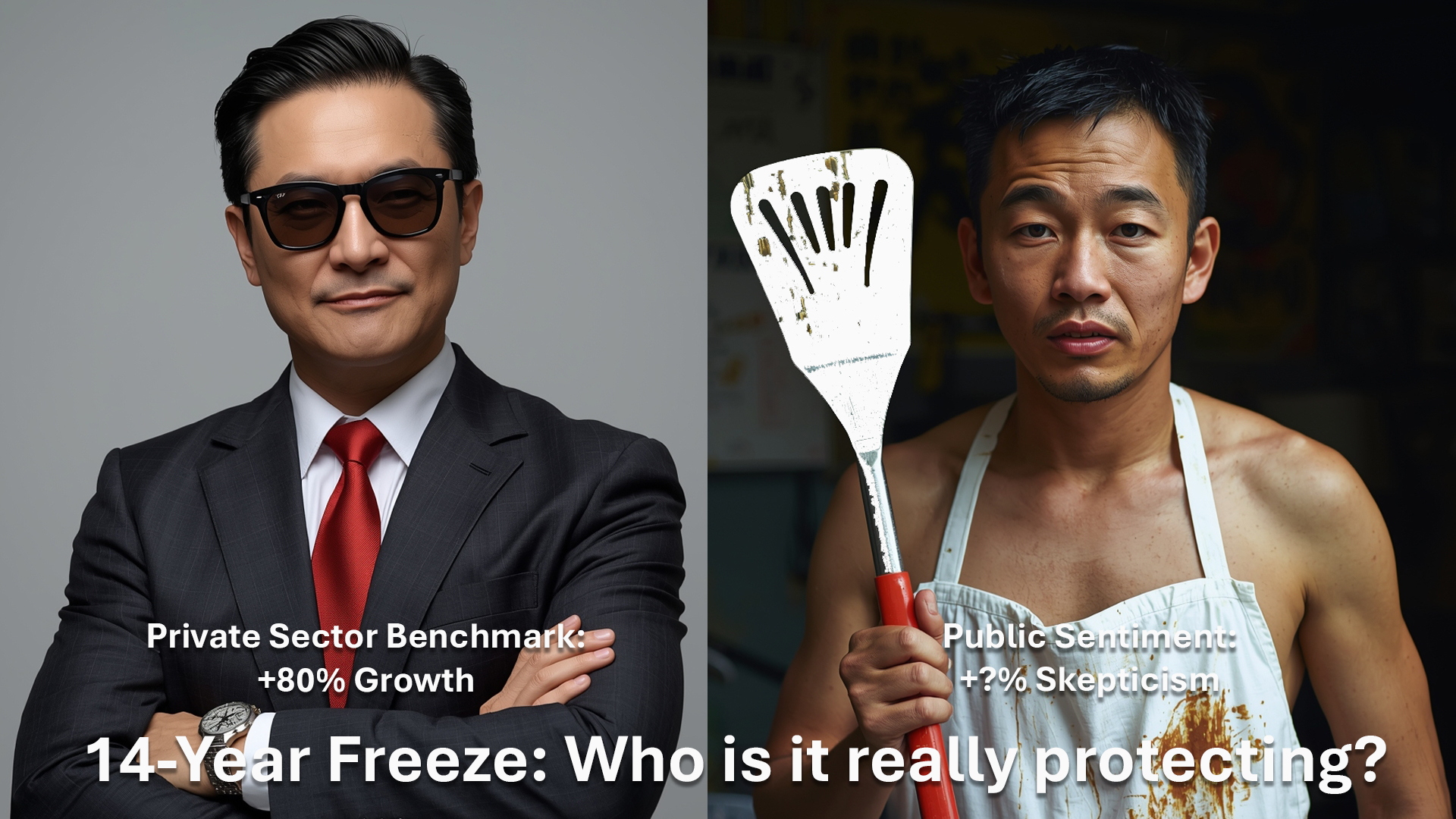
Series Title: Million-Dollar Ministers: The Great Divide
14 Years Frozen: Why the “Ministerial Pay Cut” Doesn’t Feel Like One to Us
(Part One)
1. The Invisible Pay Cut vs The Reality Gap (Fact vs Feeling)
The Math: A 14-Year Time Capsule
Imagine if your salary hadn’t moved since 2012. For Singapore’s Ministers, this isn’t a hypothetical — it’s the official record. Let’s begin with what we know.
In 2012, an entry-level (MR4) Minister’s salary was set at SGD $1.1 million. Fast forward to 2026, a recent data shared and reaffirmed in Parliament by Minister Chan Chun Sing, the “norm” salary for an entry-level Minister (MR4) has remained at SGD $1.1 million for 14 years.
This data also revealed that over the same period, the median income of Singaporeans has climbed by roughly 80% and the 20th percentile saw growth of about 87% since the last ministerial salary update in 2012 (these figures are nominal and do not account for inflation adjustments).
In the private sector, the “Top 1,000” earners (the group Ministers are bench-marked against) would have seen their incomes soar even much higher. In that same window, the salary for an entry-level Minister (MR4) has remained “frozen” at SGD $1.1 million.
The Logic: A Significant “Relative” Pay Cut
Technically, the government has a point: in a world of inflation and private-sector booms, a 14-year freeze is a significant “relative” pay cut. If the government had strictly followed its own formula, Ministers would likely be asking for SGD $2 million today. By choosing to stay “frozen,” the government argues they have effectively taken a massive relative pay cut to stay in sync with the national mood.
Meanwhile, the “Ground” has shifted significantly. In that same window, the median income for Singaporean citizens grew by 80%, and for those in the 20th percentile, it rose by 87%. Technically, the government has a point: in a world of inflation, a 14 – year freeze is a significant “relative” pay cut. If they had strictly followed their own formula, that $1.1M benchmark would likely be closer to SGD $2 million today.
On paper, this creates a technically valid argument:
- In relative terms, ministerial salaries have not kept pace with the private-sector benchmark they were pegged to.
- In economic language, that’s a form of compression.
- In ordinary language, it’s harder to call a frozen million-dollar salary a “sacrifice.”
And here is where spreadsheet logic meets kitchen-table logic.
2. The “Elitism” Problem
The Friction: Why the “Discount” Doesn’t Feel Like One
While the “Invisible Pay Cut” is technically true in a spreadsheet with our government bench-marking these salaries against the Top 1,000 Singaporean earners (among whom are the elite tier of CEOs and bankers), but here is where the “Citizen’s Voice” comes in – asking a different question: Does the benchmark even make sense?
A Benchmark Question — Not The Dollar Question
The current framework benchmarks ministers’ salaries to the median income of the Top 1,000 Singapore Citizen earners, with a 40% public-service discount applied.
The rationale is clear:
- Attract capable leaders.
- Prevent corruption.
- Remain competitive with private-sector opportunities.
There is internal consistency in this model.
While Singapore’s Top Earners group has seen astronomical growth, the average Singaporean is asking: Why is the benchmark so high to begin with? Even with a “40% discount,” a Minister’s monthly paycheck is still what a median worker takes home in nearly one or to some, even two years. When the starting point is a million dollars, the “pain” of a salary freeze feels like a luxury problem.
Critics online often point out:
- The Elitist Benchmark: The government benchmarks these salaries against the Top 1,000 Singaporean earners — the elite tier of CEOs, bankers, and top-tier professionals. If you benchmark yourself against the 0.02% of earners, you will always be “discounted” relative to them, but you remain light-years away from the average Singaporean. Why is the comparison group the Top 1,000 earners in the first place?
- The Multiplier Effect: While that group’s wealth has soared, the average Singaporean is asking: Is this the right yardstick? Even with a “40% discount” applied to reflect the ethos of service, a Minister’s monthly paycheck is still roughly what a median worker takes home in one or to some, two years.
When you start at a million dollars, the “pain” of a salary freeze is an intellectual concept, not a daily struggle to balance the household budget.
But here’s the question that rarely gets asked calmly:
- When leaders peg themselves to the uppermost tier of income, they may signal competitiveness – but they may also unintentionally signal distance.
- And in public life, perception is not a side issue — it is part of the job.
3. The 2026 Reality Check – Performance vs. Pay (The “Private Sector” Irony)
An independent committee, chaired by Mr. Gan Seow Kee, has just been convened to review these figures. They aren’t just looking at spreadsheets; they are managing a fragile social contract.
- The Government’s Dilemma: If salaries stay frozen forever, will we lose our best minds to the private sector?
- The Public’s Reality: If they do raise pay while the ground is struggling with the highest cost-of-living in decades, the “Empathy Gap” might become a permanent bridge too far.
The government often uses the “Private Sector” argument: We need to pay high to attract the best.
However, the “unofficial” online debate (on Reddit and HardwareZone) points to a glaring irony. In the private sector, if a CEO presides over major lapses — data breaches, transport breakdowns, or rising costs — their “variable bonus” or their job is at risk.
In 2026, the public is asking: If we are paying “Private Sector” prices, are we seeing “Private Sector” accountability? Or has the “clean wage” become a “comfortable wage” that stays high regardless of the ground sentiment?
4. The Emotional Mathematics of SGD $1.1 Million
Let’s humanize this without sensationalizing it.
SGD $1.1 million per year works out to about SGD $91,666 per month and (unfortunately) for many Singaporean households, that approximates one to two years of income compressed into a single month. So when the official narrative emphasizes a “14-year freeze” – it is economically factual.
But when citizens struggle with higher utilities, GST at 9%, childcare costs, or hawker prices that inch upward each year, the phrase “relative pay cut” sounds abstract.
The issue isn’t envy – It’s relatability.
A frozen SGD $4,000 salary feels different from a frozen $91,000 one — even if both are technically frozen.
5. The Private Sector Analogy — A Fair Mirror
The government’s long-standing argument is straightforward – to attract capable leaders who could earn more elsewhere, compensation must be competitive.
That is a rational position.
But here is a structural question worth asking — calmly and constructively:
If compensation is bench-marked to private-sector earnings, should elements of performance measurement also mirror private-sector structures?
In corporate settings:
- Variable bonuses fluctuate significantly.
- Compensation can respond quickly to outcomes.
- Leadership turnover is not uncommon when expectations are unmet.
Governance is not corporate management — and it should not be reduced to quarterly results. But if the justification for high pay rests on private-sector equivalence, then the public will naturally examine whether accountability mechanisms feel equivalently robust.
This is not a personal critique. It is a design question.
6. The 2026 Crossroad – Is it time to change the formula?
Perhaps the issue isn’t whether the SGD $1.1M is “frozen.” Perhaps the issue is that the formula itself—bench-marking leaders to the ultra-wealthy—inherently creates a disconnect. Should a Minister’s bonus be tied to GDP (which can grow while citizens struggle), or should it be tied to more “human” metrics like housing affordability or healthcare costs?
Mr. Gan Seow Kee’s Committee is currently reviewing these numbers. They face two very different versions of reality:
- The Official Reality: Salaries are lagging behind the private sector, making it harder to recruit top talent.
- The Public Reality: SGD $1.1M is already an astronomical sum during a period of 9% GST and high cost-of-living.
- The Verdict: The “Invisible Pay Cut” might be a fact of economics, but for the average Singaporean, it feels like a secondary issue. The real debate isn’t about whether Ministers are “underpaid” compared to bankers — it’s about whether they are “overpaid” compared to the people they serve.
7. A Re-frame: What Is Political Compensation Meant to Signal?
Perhaps we have been asking the wrong headline question for years.
Instead of “Are ministers overpaid?”, a more thoughtful question might be:
What should ministerial compensation represent in a society like Singapore?
Should it signal:
- Market competitiveness?
- Public service sacrifice?
- Shared economic experience?
- Or institutional stability?
Every benchmark reflects a philosophy – and philosophy shapes public trust more than numbers do.
8. The Trust Variable
There are two legitimate concerns happening simultaneously.
From the Government’s perspective:
“How do we ensure Singapore continues to attract capable individuals into political leadership?”
From the Citizen’s perspective:
“Do our leaders experience economic pressures in a way that feels recognizable to us?”
These questions are not enemies of each other. But they are not the same question. And when citizens feel unheard, online discourse often turns emotional — sometimes unnecessarily so.
This conversation deserves better than outrage. It deserves clarity.
9. A Thought Worth Exploring
What if the formula evolved? Not dramatically or reactively – but incrementally.
Imagine a hybrid model:
- A core benchmark tied to high-level professional earnings.
- A variable component linked to median income growth.
- A portion indexed to cost-of-living indicators like housing and healthcare.
Such a structure would not abandon competitiveness (with transparency and fairness). But it would symbolically anchor leadership compensation to broader social conditions. And symbols matter in public life.
10. Closing
This article is not about punishing success or attacking leadership. It is about alignment.
When leaders benchmark upward, they may attract talent.
When leaders align downward, they may deepen trust.
Singapore does not need louder arguments on this issue – it needs sharper ones.
Because in the end, political salaries are not just about dollars.
They are about what kind of society we believe we are building — and who we believe stands alongside us while building it.
Trust, unlike salary, cannot be frozen.
Sources
1. Official Framework & Benchmarks
- The 2012 White Paper: The current salary structure is based on the “White Paper on Salaries for a Capable and Committed Government (Cmd. 1 of 2012)”. This established the $1.1 million “norm” for an entry-level Minister (MR4). Reference: Public Service Division (PSD) – Salary Components of Ministers.
- The Formula: The MR4 salary is benchmarked to the median income of the Top 1,000 Singapore Citizen earners, with a 40% “public service discount” applied. Reference: CNA Explains: How are political salaries in Singapore calculated?
2. 2026 Real-Time Parliamentary Data
- The 14-Year Freeze: Minister-in-charge of the Public Service, Chan Chun Sing, confirmed in a written parliamentary reply on February 4, 2026, that ministerial salaries have remained unchanged since 2012.
- Income Growth Stats (2012–2026): In the same reply, Minister Chan cited Ministry of Manpower (MOM) data showing:
- Median Income Growth: Increased by 80%.
- 20th Percentile Growth: Increased by 87%. Reference: Mothership – S’pore ministerial salaries unchanged since 2012
3. The 2026 Review Committee
- Committee Formation: An independent committee was officially convened on January 12, 2026, to review the current framework.
- Chairman: Mr. Gan Seow Kee (Chairman of Singapore LNG Corp and Alternate Member of the Council of Presidential Advisers).
- Members: The 8-person committee includes representatives from the private sector, unions, and academia (e.g., Professor Lily Kong, President of SMU). Reference: PSD – Review of Political Appointment Holders’ Salaries (Jan 2026)
4. Key Comparative Salaries (2026)
- Prime Minister: $2,200,000 (Fixed at 2x MR4).
- President: $1,540,000 (Fixed at 70% of PM’s package).
- MP Allowance: $192,500 per year. Reference: SmartWealth – Salaries of Singapore’s President, Ministers & MPs (2026).
Author: Gui
AI Assistant: ChatGPT Aria (private) X Gemini Maya (private) X Leonardo AI
Published: 2026/02/12